Hygienic Rotary and Diverter Valves for Food Processing

Enhancing Quality and Safety in Food Processing Through Innovative and Reliable Solutions

Boosting Safety and Efficiency for Increasingly Complex Processes in Food Production

The food industry is characterized by a diverse and ever growing product portfolio, strict regulations as well as complex production processes with a high degree of automation. As a consequence, food manufacturers have been required to think more like system integrators over the last decades and put more thoughts in, among other things, an optimal flow of materials.

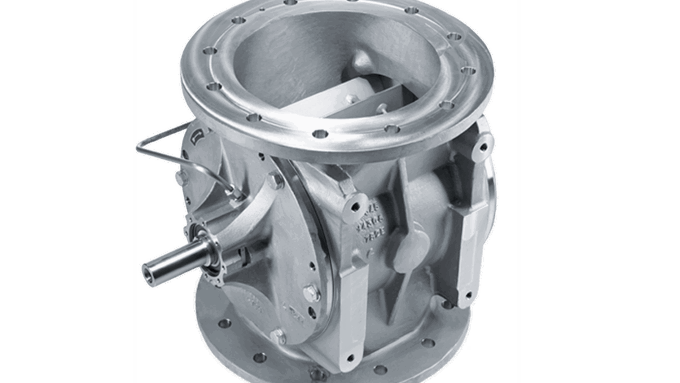
Rotary and diverter valves are some of the key components in many food processes. They ensure an efficient transport of the ingredients or the conveying good while controlling the flow rate. Their hygienic and gentle handling of different types of bulk solids, from flour and sugar to grains and dairy powders, thus ensures smooth operation across all production stages. In addtion, rotary and diverter valves must facilitate frequent proudct changeovers and minimize the risk of cross-contamination without  mitigating productivity. Valve designs must meet these demands through cleanability, durability, and easy maintenance to minimize downtime and reduce operational costs.

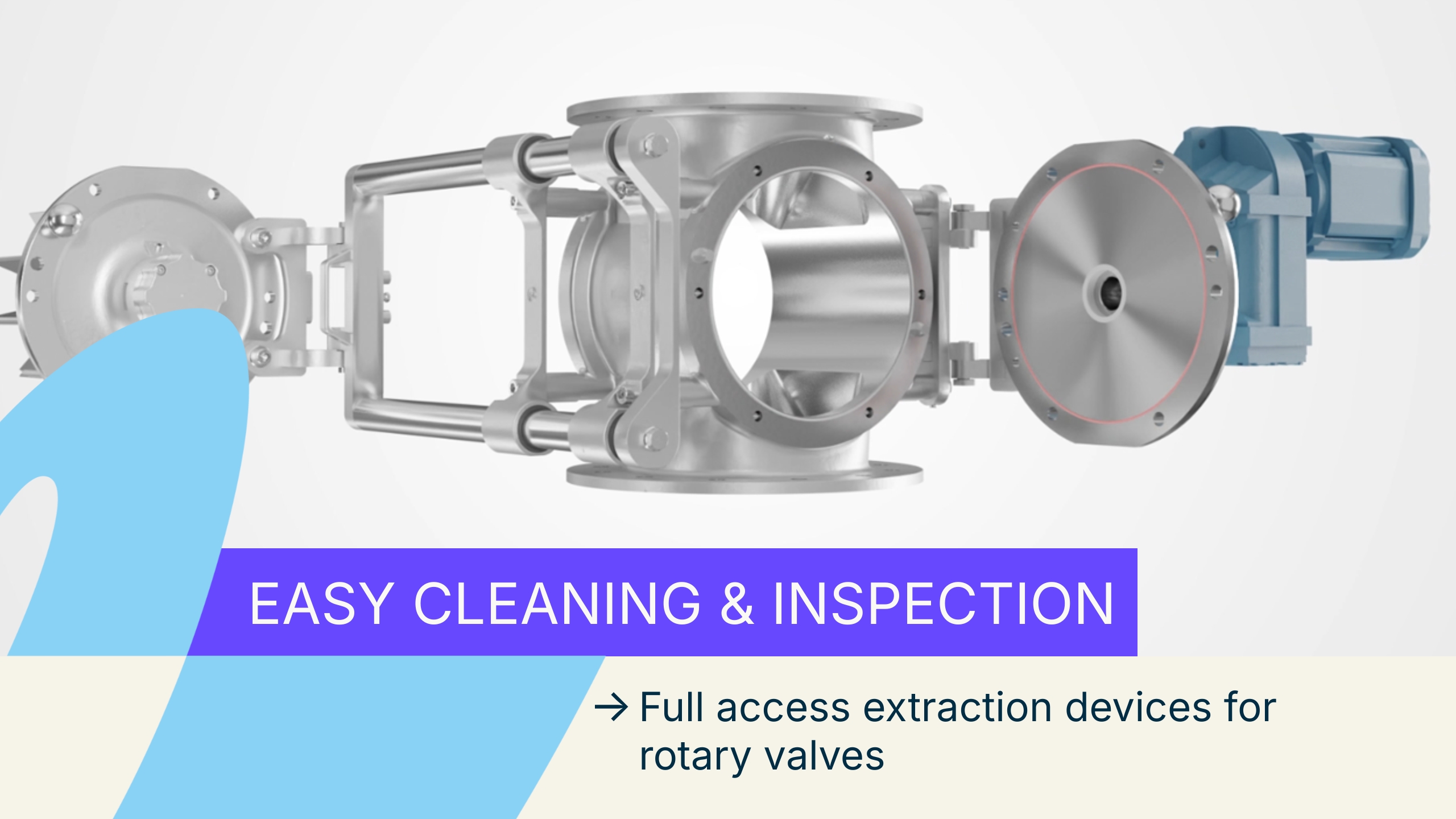
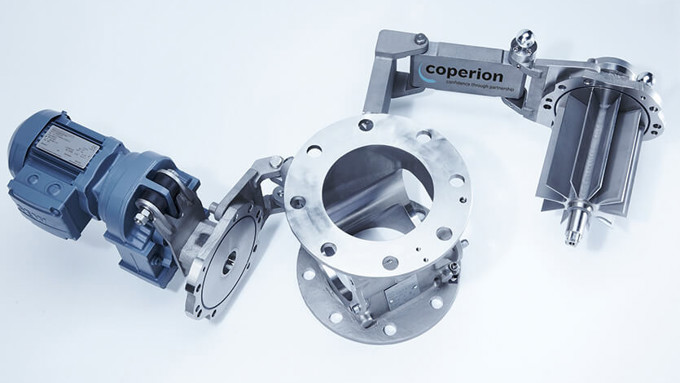
Coperion components have proved their reliability in the food industry over many years. They innovative sanitary and cleaning friendly designs are optimized for time and ultimately cost savings. Newest developments such as the full access devices for bigger rotary valves have been designed with the user in mind and allow for easy handling of the systems.

Your Challenge Is Our Motivation

Continuous Innovation with Operators in Mind

At Coperion, our deep expertise in the food industry allows us to design rotary and diverter valves with cleanability and user-friendliness at the forefront. We design innovative solutions that simplify cleaning, reduce downtime, and support compliance with food safety standards.

TALK TO EXPERT

Typical Application of Coperion Valvens in Food Processing

The production of dairy products is a complex and carefully controlled process that transforms fresh milk into a variety of products, including milk powders, infant formula or ice cream. Each product requires specific techniques to ensure quality, safety, and nutritional value. A critical component of this manufacturing process is the use of rotary valves. These valves are essential for controlling the flow of liquids and powders at various stages of production. They ensure precise measurement and consistent delivery of ingredients, which is vital for maintaining product quality and reaching the needed product characteristics (e.g. granularity). In addition, rotary valves are instrumental in managing the flow of probiotics and lactase enzymes during the production of yogurt and lactose-free products, respectively. Their reliability and efficiency contribute significantly to the overall effectiveness of dairy production, ensuring that high-quality products reach consumers.

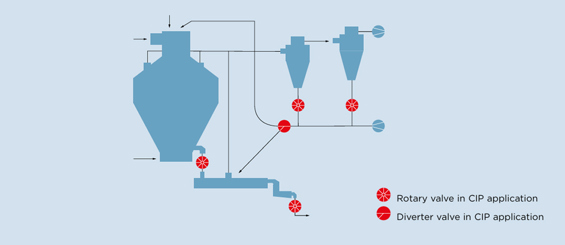
The production and handling of starches involve a series of intricate steps that transform raw materials, such as corn, potatoes, or tapioca, into versatile starch products used in various food and industrial applications. This process is essential for creating ingredients that enhance texture, stability, and viscosity in numerous products. A key element in the starch production process is the use of rotary and diverter valves. These valves play a vital role in controlling the flow of raw materials and processed starch at different stages. For example, during the initial grinding and separation of starch from the raw material, rotary valves ensure precise measurement and consistent delivery of the slurry to the next processing stage. As the starch undergoes further processing, including washing, drying, and packaging, rotary valves facilitate the efficient transfer of materials, while diverter valves allow for the redirection of materials between different processing lines or storage silos.

The production and handling of coffee involve a meticulous process that transforms raw coffee beans into actual coffee. This journey encompasses several stages, from harvesting and processing to roasting and packaging, each critical for developing the coffee's unique flavor profile. A vital component of this process is the use of rotary valves and diverter valves. Rotary valves are essential for controlling the flow of coffee beans and other ingredients at various stages. For instance, during the transfer of green coffee beans from storage to roasting machines, rotary valves ensure precise measurement and consistent delivery, which is crucial for achieving uniform roasting. Diverter valves also play a significant role by allowing the redirection of coffee beans between different processing lines, such as moving roasted beans to packaging or blending areas. This flexibility is essential for managing production efficiently and maintaining the quality of the final product.

The handling of food ingredients, including herbs, spices, spice blends, bakery ingredients, flour, and cornmeal, involves a series of processes designed to ensure quality, consistency, and efficiency. These ingredients are often processed in bulk, requiring precise control over their flow and handling to maintain their unique characteristics and flavors. Rotary valves and diverter valves are essential components in this handling process. Rotary valves facilitate the accurate measurement and transfer of dry ingredients, such as flour and spices, from storage silos to mixing or packaging equipment. Their ability to provide consistent flow is crucial for maintaining the integrity of recipes and product formulations. Diverter valves complement this by allowing for the redirection of ingredients between different processing lines or storage areas, enhancing flexibility in production. Together, these valves optimize the handling of food ingredients, ensuring that high-quality products are efficiently processed and delivered to meet the demands of the food industry.

Critical Considerations in Food Processing Applications

Hygiene design, contamination prevention, and reliable operations are crucial for boh product safety and process efficiency. In addition, food manufacturers face increasing pressure to maximize productivity, reduce downtime, and above all maintain compliance with food safety regulations.

To meet these requirements, you need components that combine hygienic standards and cleanability with efficiency. 

How does Coperion address these challenges? Here are some of the answers to the most common customer questions when it comes to food applications.

  • Are Coperion valves designed for easy cleaning and sanitation?

    Lorem ipsum dolor sit amet, consetetur sadipscing elitr, sed diam nonumy eirmod tempor invidunt ut labore et dolore magna aliquyam erat, sed diam voluptua. At vero eos et accusam et justo duo dolores et ea rebum. Stet clita kasd gubergren, no sea takimata sanctus est Lorem ipsum dolor sit amet. Lorem ipsum dolor sit amet, consetetur sadipscing elitr, sed diam nonumy eirmod tempor invidunt ut labore et dolore magna aliquyam erat, sed diam voluptua. At vero eos et accusam et justo duo dolores et ea rebum. Stet clita kasd gubergren, no sea takimata sanctus est Lorem ipsum dolor sit amet.

  • Are there dead zones or product buildup risks?

    Lorem ipsum dolor sit amet, consetetur sadipscing elitr, sed diam nonumy eirmod tempor invidunt ut labore et dolore magna aliquyam erat, sed diam voluptua. At vero eos et accusam et justo duo dolores et ea rebum. Stet clita kasd gubergren, no sea takimata sanctus est Lorem ipsum dolor sit amet. Lorem ipsum dolor sit amet, consetetur sadipscing elitr, sed diam nonumy eirmod tempor invidunt ut labore et dolore magna aliquyam erat, sed diam voluptua. At vero eos et accusam et justo duo dolores et ea rebum. Stet clita kasd gubergren, no sea takimata sanctus est Lorem ipsum dolor sit amet.

  • How do you handle leakage gas to avoid contamination?

    We eliminate leakage gas contamination risk through an innovative rotary valve design.

    Most conventional rotary valves for powder handling use a separate leakage gad discharge vent on the housing or directly above the valve. While this setup is common, it can lead to product residues accumulating in the external piping. Ths can create risk of cross-contamination and hygiene issues. At the same time, separate leakage gas vents come with additional investments including installation and maintenance costs.

    Coperion rotary valves solve this challenge by eliminating the need for external leakage gas discharge vents. Our design minimizes dead zones, simplifies cleaning, and ensures maximum operational reliability and hygiene. This results in lower total cost of ownershio and improved process safety.

    Learn More

Want to Discuss Your Individual Challenge with Us?

Get in Touch With Us!

Coperion has experience with a wide variety of food applications. With our innovative solutions and different customization options, we are confident to find the right components for your specific requirements.

Contact us

Find the Right Coperion Valve for Your Application

FXL & FXS Full Access Extraction Devices for Rotary Valves

Play video
Coperion FX (full access) extraction devices for rotary valves have been developed especially for applications with strict hygienic requirements in food production. These systems offer free, unimpeded access to the rotary valve’s interior, for fast and easy cleaning or inspection.